Know before it breaks

See every machine.
Know every dollar.

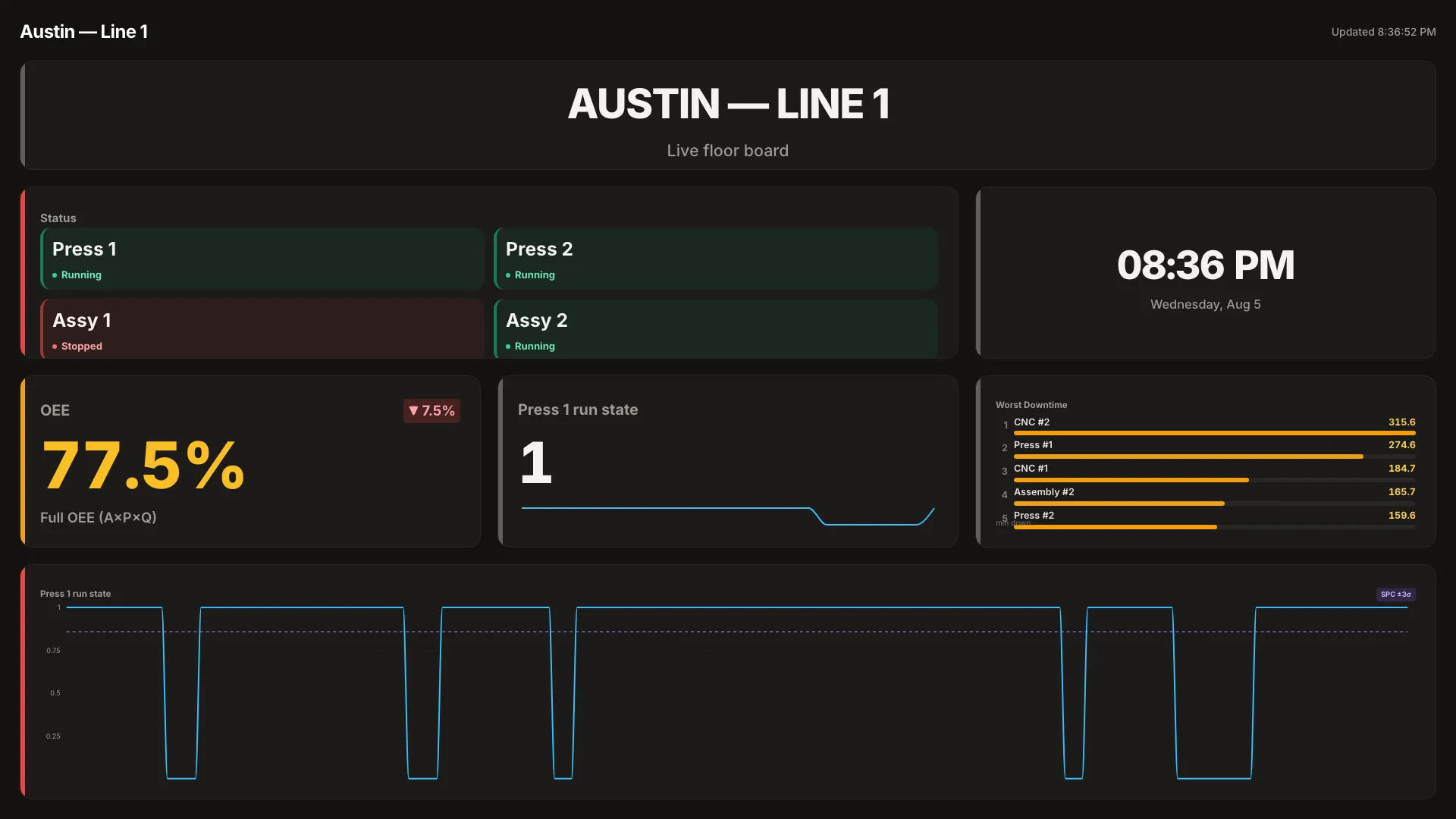
A palm-sized gateway speaks to your PLCs — Siemens, Allen-Bradley, FANUC, Modbus, OPC-UA and more. By the end of the afternoon your floor has live OEE, wallboards, andon — and an AI that starts finding the dollars.

$4,500 flat · hardware included · 100% credited on conversion

product tour · 26s · live demo data LIVE

The receipts

Not another dashboard. A machine for finding money.

Illustrative — from our own bench/demo data, not yet a customer's floor

$19,945/wk

one setpoint's scrap difference — found, priced, attributed

45sec

early warning the AI found on a tag nobody had wired up

$2,744/wk

changeover tax on a single line, measured from real transitions

1afternoon

from unboxing the gateway to live wallboards on the floor

Act

Every insight arrives
as a dollar figure.

The Opportunities board ranks where capacity is leaking — in your money, at your rates, with the evidence attached. A self-training AI finds predictive signals, prices your setpoints, and flags failure risk before it stops the line.

  • $-ranked losses with provenance — no generic "ROI calculator" math
  • What-if calculator: OEE points → dollars per year, on your numbers
  • And when the data is thin, it says so — it abstains, never fabricates
opportunities · ranked by $ impact
Opportunities board ranking losses by dollar impact, top item $508,888
downtime pareto · biggest losses first
Downtime Pareto showing lost minutes by reason with changeover tax

Understand

A flight recorder
for every stop.

Downtime pareto, changeover tax, scrap attribution — and the context around them: operator notes, setpoint changes, checklists and work orders on one timeline. When Line 2 went down at 2 a.m., you'll know why, in minutes not meetings.

  • Biggest-loss-first, always — fix what recovers the most capacity
  • Changeover matrix with a weekly "tax" figure per line
  • Shift handoff briefs that write themselves

See & count

Honest OEE, at every level
of the plant.

From enterprise to site to line to machine — one league table, one yardstick. TV wallboards (English/Spanish) on the floor, andon with response times, benchmarking that flags what the best line does differently.

  • ISA-95 rollups: availability × performance × quality, weighted — never fudged
  • Missing data reads "—", not a made-up number
  • Cross-site league table: copying your own best line is free capacity
benchmarking · the league table
Benchmarking league table across three plants and eight lines

Install

Live before the shift ends.

No integrator. No six-month project. No rip-and-replace.

01

Wire the box

DIN-rail gateway, dual-NIC, pre-flashed. Power + network on the machine side. It phones home with a claim code — no laptop on the floor.

02

Point it at machines

Guided wizard: pick a protocol (19 supported — S7, AB, FANUC FOCAS, Modbus, OPC-UA…), test the connection, discover tags. The commissioning screen green-checks every signal live.

03

Watch it find money

Wallboards on the TVs the same day. The AI starts learning each machine's normal — first dollar-priced findings typically inside two weeks.

commissioning · every tag verified live
Commissioning wizard showing four tags reading live values, all healthy

Specifications

The cut sheet, straight.

The box, the wiring, and the posture — the way you'd read it off a spec sheet before you bolt anything to the wall. No IP rating or temp range we haven't verified on metal; if it's not here, we haven't proven it yet.

Gateway
DIN-rail box — Raspberry Pi CM4 on an industrial carrier, dual-NIC (one port faces your machines, one faces the uplink). Pre-flashed; no laptop on the floor.
Protocols
19 supported across three families — PLCs & controllers (Siemens S7, Allen-Bradley, Omron, Mitsubishi, LS Electric, OPC-UA), CNC/sensors/meters (FANUC FOCAS, Modbus TCP/RTU, direct-wired digital & analog), and a raw-connector escape hatch. Connects over Ethernet, Serial, or wired straight into the panel.
Data path
Outbound-only. Telemetry leaves over MQTT/TLS, the control-plane over HTTPS. No inbound port opened on your plant network, no VPN, no static IP. Dual-NIC keeps the OT side segregated.
When the internet drops
The box keeps polling and buffers on-site (store-and-forward). Wallboards on the floor keep running; when the connection returns it backfills — an outage is visible, not silently lost.
Read-only posture
Never writes to your PLCs. There is no code path in the product that writes back to a controller — not by default, not on request. It reads and recommends; your people act.
If the box dies
We ship a replacement, pre-flashed the same. DIN-rail swap, power it up, it claims itself and the cloud re-pushes its config. About ten minutes, no expertise on site — think of it like a warranty swap.

General notes

The four questions maintenance always asks.

Does it need our IT?

No. One network drop on the machine side, one on the uplink. Nothing to stand up, no ports to open, no static IP.

What happens when the internet drops?

The box keeps polling and buffers on-site. The wallboards keep running, and when the connection comes back, nothing is lost — it backfills.

Can it write to my PLCs?

No. Read-only, period. There is no code path that writes back to a controller. It reads and recommends; your people act.

What if the box dies?

We ship a replacement. Swap it on the DIN rail, power it up, it pulls its config back down — about ten minutes. Treat it like a warranty swap.

Read-only by contract

Spall never writes to your PLCs. It recommends; your people act. Your controls engineer sleeps fine.

No lock-in — provably

Live Excel/OData feeds, SQL access, a real API. Your data leaves whenever you want it to. Ask other vendors for raw egress and watch the meeting change.

Honest by design

No fabricated numbers, anywhere. Thin data reads "—". The AI abstains when unsure. Trust is the product.

Pricing

Priced under 5% of what it finds.

Starter

$500/mo

One line, up to 3 machines.

  • OEE, downtime & quality
  • Kiosk wallboards + andon
  • Checklists & shift handoff
MOST PLANTS

Plant

$150/machine/mo

Volume steps at 10 and 25 machines.

  • Everything in Starter
  • Full AI suite: discovery, setpoint impact, golden runs, failure risk
  • Cost model, job costing, PM, energy
  • Benchmarking & what-if

Enterprise

$50k/yr+

Multi-site groups.

  • Cross-site benchmarking & exec digests
  • API at scale, priority support
  • Named customer engineer

Gateway hardware $1,500/unit — fully credited against expansion. Annual prepay −15%.

Why Spall exists

Built by someone who's
carried the clipboard.

John Holloway spent a decade inside plants — process engineer, systems integrator, and senior data analyst at Charlotte Pipe & Foundry, then rolling out manufacturing data platforms across 100+ machines with zero churn, and finding $3.2M in annual savings hiding in operational data at Electrolux.

Spall is the tool he kept wishing existed: old machines, new data, practical AI — live in an afternoon, priced in dollars found.

John Holloway · Founder · Charlotte, NC

The pilot pays for itself,
or that's your answer.

30 days, one line, hardware included — $4,500, fully credited when you expand. Success criteria in writing: a loss board you believe, and at least one finding worth more than the pilot.

or email us directly — pilots@spall.cc